SK hynix reports KRW 83.3 trillion operating profit; KRW 100 trillion shareholder-return plan to unfold through payment of the final dividend for fiscal 2026
EEJE Editorial Team · English edition
Semiconductor production facilities and a technician. AI-generated.
SK hynix disclosed preliminary consolidated third-quarter revenue of KRW 104.6155 trillion and operating profit of KRW 83.3338 trillion on October 28. Revenue rose 31.9% and operating profit 37.6% from the previous quarter. The approximately KRW 100 trillion in shareholder returns announced the same day was not money paid out or spent on October 28 alone. The company said in its disclosure that it planned to carry out the returns in stages through payment of the final dividend for fiscal 2026. Preliminary operating results disclosure, Disclosure of shareholder-return measures
The preliminary results give exact revenue of KRW 104.615483 trillion and operating profit of KRW 83.333818 trillion. Net profit was KRW 39.775593 trillion, down 57.7% from the previous quarter. These amounts have been converted into won from the disclosure’s reporting unit of KRW millions. The figures are preliminary, have not completed an external audit and may change when finalized. The rise in operating profit and the fall in net profit concern different measures of earnings; presenting both shows the composition of this quarter’s profit. Original preliminary results table
The company estimated approximately KRW 100 trillion in shareholder returns for the current fiscal year, describing cash dividends of at least KRW 30 trillion and share repurchases and cancellations of at least KRW 60 trillion. The figures include KRW 40 trillion in share repurchases and cancellations approved in August and exclude shares acquired for employee compensation. The company also cautioned that the total is forward-looking and may change depending on business conditions and results. Shareholder-return plan disclosure
The quarterly cash dividend approved by the board on October 28 is KRW 20,000 per common share. The total dividend is approximately KRW 14.1035 trillion and may vary with the number of shares outstanding on the record date. That date is November 30, and the company said it planned to pay within one month of it. The per-share dividend includes KRW 10,000 reflecting operating results and a KRW 10,000 special dividend related to Kioxia. The company plans to return gains from its Kioxia investment through this quarterly dividend and the final dividend. Cash dividend decision, Shareholder-return plan
The approved share repurchase has a planned value of KRW 20.00772 trillion and covers 14.92 million common shares. The exchange purchase period runs from October 29 to January 28 next year. The company expected to use approximately KRW 10 trillion for shareholder returns and approximately KRW 10 trillion for employee compensation. Counting the entire roughly KRW 20 trillion as shares to be canceled for shareholder returns would also count shares intended for compensation as shareholder returns. Share repurchase decision, Breakdown by intended use
The size of additional repurchases has not been fixed all at once. The company said the board would determine amounts each quarter, taking market conditions and cash flow into account, and that shares acquired for shareholder returns would be canceled. The announced total, the amount approved in this resolution and the amounts actually purchased or paid are different stages. This article does not include closing prices for SK hynix shares or the KOSPI, which would be confirmed after the market closed. Company fair disclosure
EEJE Editorial Analysis: To assess what shareholders will receive, the headline total needs to be considered alongside the dividend record date, purchase period and whether shares will be canceled. This disclosure fixes the per-share dividend and the terms of the current repurchase resolution; approximately KRW 100 trillion is a projected plan extending through payment of the final dividend. The company’s separation of shares for employee compensation from those for shareholder returns makes that distinction clear. Comparison of dividend, repurchase and shareholder-return measures
Democratic Party seeks inquiry into Chief Justice Cho; request must be reported to plenary and plan approved
EEJE Editorial Team · English edition
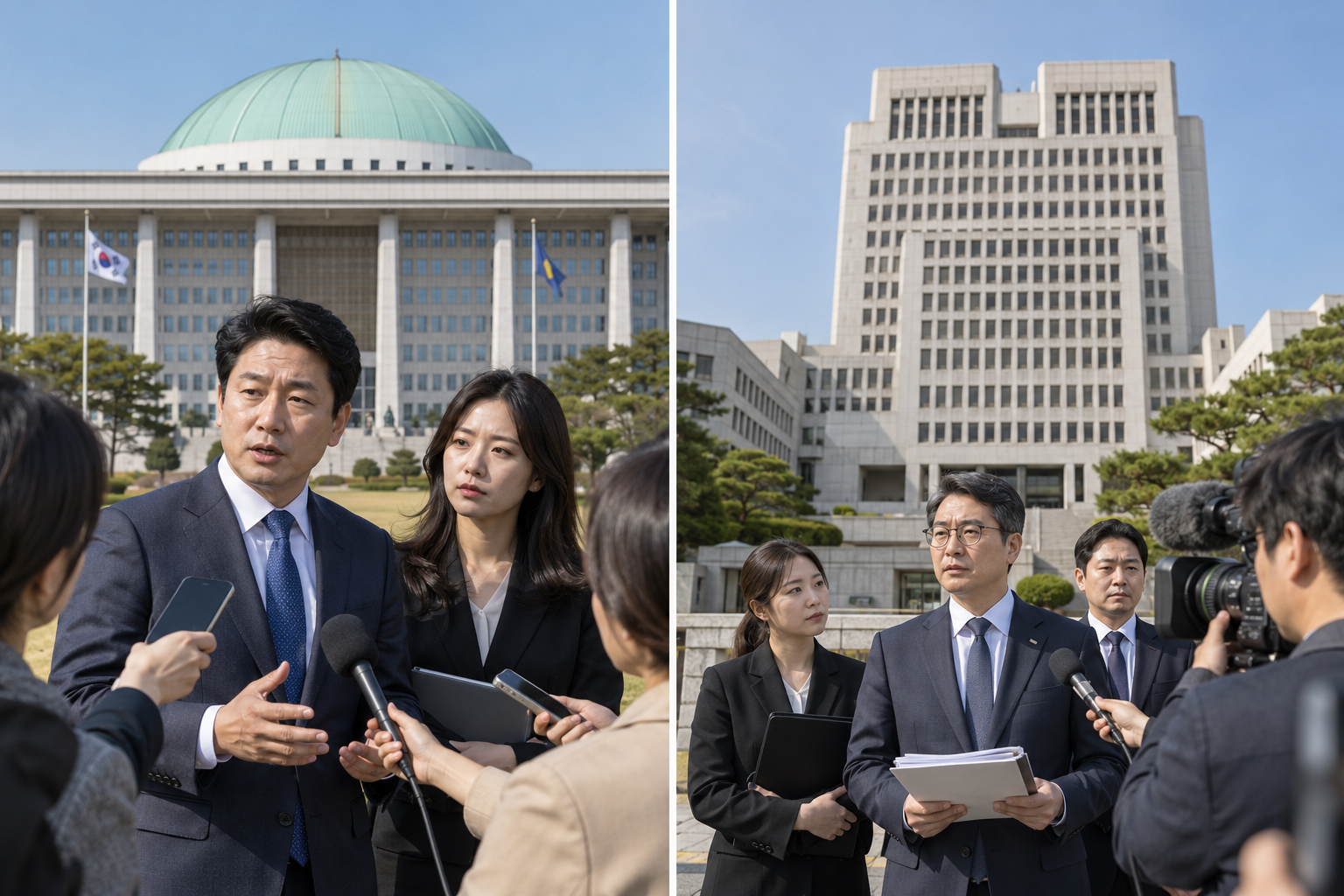
Parliament and judicial institutions in dispute. AI-generated.
The Democratic Party of Korea agreed at its October 27 caucus meeting to pursue a parliamentary inquiry concerning Chief Justice Cho Hee-dae. After the meeting, floor spokesperson Jeon Eun-soo said the party had delegated further action to its leadership. The party’s decision to pursue an inquiry is a separate step from the National Assembly authorizing one. Before an inquiry can begin, the request must be reported to a plenary session, and the plenary must approve the plan prepared by the inquiry committee. CBS No Cut News, remarks after the October 27 caucus meeting, Article 3, Act on the Inspection and Investigation of State Administration
Article 3 of the Act on the Inspection and Investigation of State Administration allows at least one-quarter of all National Assembly members to request an inquiry, specifying its purpose, scope and responsible committee. The Assembly speaker reports the request to the plenary and then determines the inquiry committee, which submits an inquiry plan. That plan sets out the purpose, scope, methods, duration and necessary expenses. Plenary approval gives concrete form to the inquiry’s authority and schedule. Article 3 of the Act
The Democratic Party has set November 5 as its target date. Reports differ, however, on what it intends to complete that day. CBS reported that the spokesperson described a goal of securing approval for the inquiry plan; the Hankook Ilbo described a sequence in which the request would first be reported, followed by formation of the committee and preparation of the plan. The full party briefing, the filing record for this request and a confirmed parliamentary agenda were not obtained, making it difficult to establish precisely what is to be dealt with on November 5. CBS report on the caucus meeting, Hankook Ilbo, October 28
Reported issues for the inquiry include a refusal to resubmit a nomination for Supreme Court justice, refusal to take the witness oath during a parliamentary inspection, and allegations concerning the use of official business expenses. The final scope will be specified in the request and inquiry plan, so not every matter mentioned by the party or individual lawmakers can be treated as an approved subject of investigation. The spokesperson’s statement that impeachment was not discussed at this caucus meeting was also reported separately from the decision to pursue an inquiry. CBS, remarks after the caucus meeting, Hankook Ilbo
The People Power Party objected, calling the move an infringement on judicial independence. Floor leader Chung Jeom-sik’s objections and the Democratic Party’s calls to investigate the allegations are the respective parties’ positions. An official Supreme Court statement on this decision was not obtained. Party criticism or comments by a sitting judge cannot substitute for the Supreme Court’s institutional position. CBS report on the caucus meeting and opposition response
EEJE Editorial Analysis: The scope and methods chosen for the inquiry will show what documents and explanations the National Assembly intends to demand from the judiciary. What has been confirmed so far is the Democratic Party’s decision to pursue an inquiry. The request and plan to be released next will specify its subjects, duration and methods. Their contents, and whether the plenary approves the plan, will determine whether a party’s political declaration becomes an actual parliamentary inquiry. Comparison with Article 3 of the Act
Daishin Securities breach affects 38,490 customers; account and mobile numbers among three fields marked as encrypted
EEJE Editorial Team · English edition
A securities firm’s response to protect customer information. AI-generated.
Daishin Securities has disclosed and apologized for a breach of personal and credit information affecting 38,490 customers. An official notice issued in the name of CEO Jin Seung-wook says the company detected an unlawful external access attempt on October 17 and, following an investigation, became aware of the data breach on October 26. The company listed eight fields of potentially exposed information; the fields actually compromised differ from customer to customer. Daishin Securities’ official breach notice and apology
The listed fields are customer name, email address, address, communications ID, bank name, deposit and withdrawal account number, Daishin Securities comprehensive account number, and mobile phone number. The encryption label appears individually beside the deposit and withdrawal account number, Daishin Securities comprehensive account number, and mobile phone number. The notice does not say that all eight fields were encrypted. “Communications ID” is the notice’s own term; no basis was established for expanding it to mean telecommunications-carrier identification information. Exposed data fields in the official apology
Daishin Securities listed measures including blocking the accessing IP address, checking vulnerabilities, strengthening monitoring, notifying regulators and cooperating with investigations. While saying that no secondary harm had been identified as of the notice, the company warned that the exposed information could be misused and cautioned against impersonation attempts. Its statement that no harm had been identified so far is narrower than a guarantee that no further harm will occur. Official information on response measures and harm
The company also explained avenues of redress available to customers, including claims for damages, claims for statutory damages and applications for dispute mediation. This guidance does not contain a promise of automatic compensation for every customer or payment in full. The specific harm and loss, the claims process and actual compensation outcomes each require separate confirmation. Redress procedures in the company notice
The company warned customers about contacts seeking personal information or inducing money transfers under the pretext of compensation for the breach. The notice lists its Financial Support Center numbers as 1588-4488 and 1544-4488. These are the official contact details the company provided, allowing customers to compare them with the numbers used by people who approach affected customers first. Official contacts and precautions
EEJE Editorial Analysis: Customers need to know which fields were encrypted and which were not, the extent of harm the company has identified, and the redress channels they can actually use. The measures the company says it has taken and the losses for which customers have received compensation need to be tracked separately. This notice reports the scale of the breach, the response and the claims channels; it is not a record of blanket compensation outcomes. Review of the official notice
Civil-service pension starting ages of 62–65 remain in place after 4–4 Constitutional Court split falls short of invalidation threshold
EEJE Editorial Team · English edition
A retired civil servant receives pension advice. AI-generated.
The Constitutional Court has left in place provisions setting the starting age for civil-service pension payments at 62–65, depending on the year of retirement. In its October 22 ruling in the consolidated cases 2024Hun-Ma990 and 2026Hun-Ba197, the justices split 4–4. Because the six votes needed to find the provisions unconstitutional or grant the constitutional complaint were not reached, the complaint was rejected and the provision challenged in the consolidated case remained constitutional. Describing the result as a majority of justices supporting constitutionality would misrepresent the distribution of opinions. Constitutional Court decision, pages 1 and 23
The provisions apply to people who meet the relevant retirement-year conditions among civil servants appointed between January 1, 1996, and December 31, 2009, who were in service on January 1, 2016. They also cover people appointed in 2010 or later who have had qualifying service as civil servants, military personnel or private-school personnel credited in aggregate under the law. Pension payments begin at 62 for those retiring in 2024–2026, 63 for those retiring in 2027–2029, 64 for those retiring in 2030–2032, and 65 for those retiring in 2033 or later. This decision did not newly raise the pension starting age to 65 for all civil servants. Applicable provisions, decision pages 4–5
Justices Jeong Hyeong-sik, Kim Bok-hyeong, Cho Han-chang and Oh Young-jun favored rejecting the complaint and upholding the provisions. They considered the public interest in stabilizing pension finances, as well as the option of taking an early retirement pension. Justices Kim Hyeong-du, Jeong Jeong-mi, Jeong Gye-seon and Ma Eun-hyeok favored granting the complaint and finding the provisions unconstitutional, citing protection of legitimate expectations and property rights. The operative outcome leaving the provisions in place needs to be presented together with the two sets of opinions evaluating them. Decision, pages 13–23
Choosing an early retirement pension before the normal starting age comes with a reduction. The payment rates reproduced in the decision are 95%, 90%, 85%, 80% and 75%, depending on the number of years remaining until the starting age. The opinion favoring unconstitutionality noted that taking the pension five years early means a 25% reduction that applies throughout the pension payment period. That maximum reduction cannot be generalized to all civil servants or everyone who takes a pension early. Decision, pages 5 and 20–21
Justice Kim Hyeong-du’s supplementary opinion addressed the need to design rules that connect the mandatory retirement age with the start of pension payments. The issue is that a gap may remain even if the mandatory retirement age is extended, because the pension starting age is determined by the year of retirement. This was a justice’s view on legislative and institutional reform; it does not mean that this ruling put a retirement-age extension into effect. Supplementary opinion, decision pages 23–30
Eight participating justices are listed at the end of the decision. Reports including YTN state that Constitutional Court President Kim Sang-hwan did not take part because a law firm where his child works was representing a party. The full decision itself did not provide an official record establishing the reason for his recusal, so that explanation is attributed to the reporting. YTN, October 27
EEJE Editorial Analysis: This decision leaves the pension starting-age provisions in place. At the same time, half of the justices raised concerns about the waiting period before payments begin and an early-payment reduction that can last for life. For someone preparing to retire, the practical issue extends beyond the finding of constitutionality to how the date of appointment, retirement year and early-payment conditions determine when payments begin and how much they receive. The two opinions differed on whether the system could adequately address that gap. Comparison of the decision’s disposition and opinions
Guryong Village fire extinguished after about 13 hours; relief for residents and cause investigation remain
EEJE Editorial Team · English edition
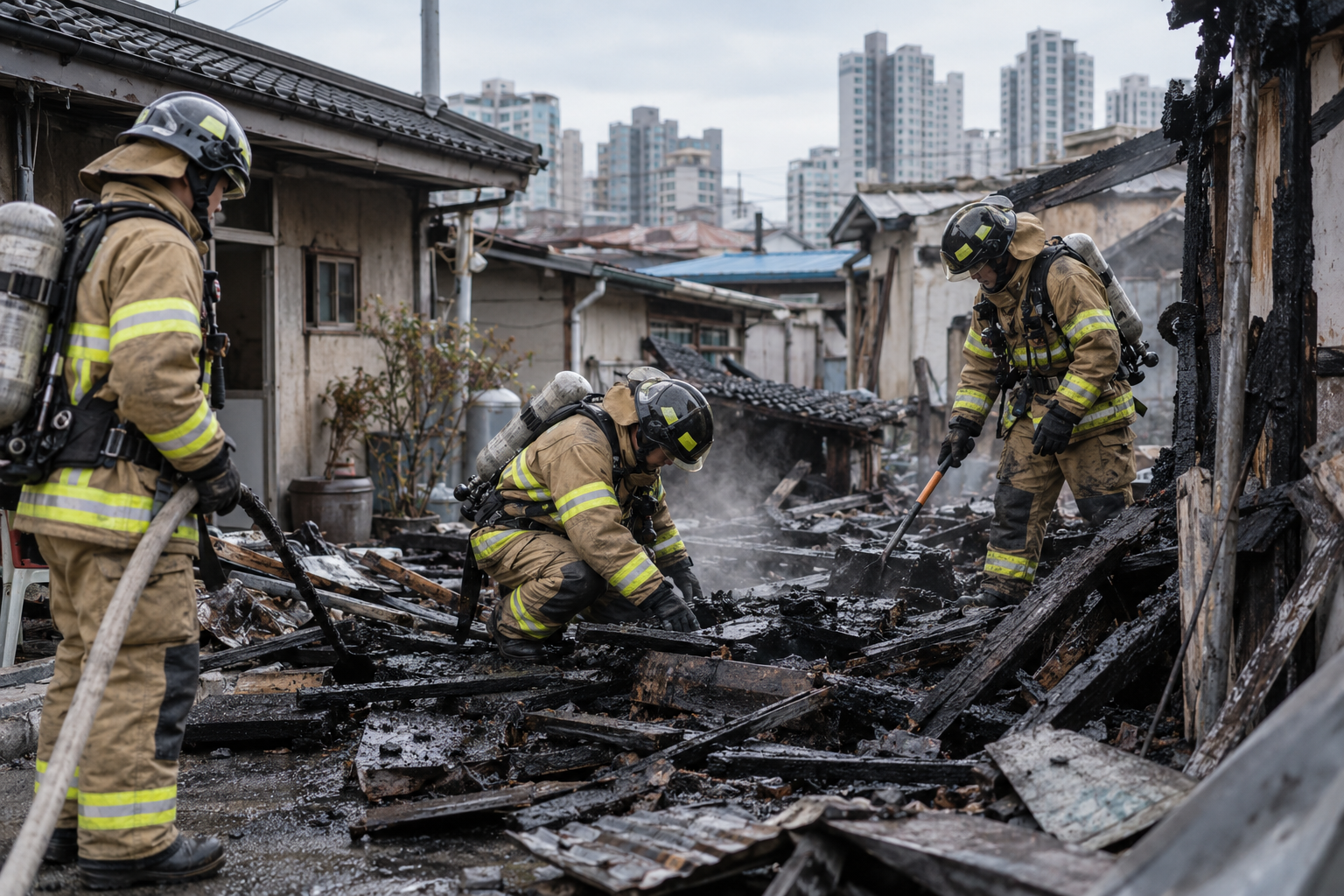
An investigation after a fire in a low-rise residential area. AI-generated.
A fire that broke out in Guryong Village in Seoul’s Gangnam district on the afternoon of October 27 was fully extinguished at 4:39 a.m. on October 28, according to reports citing fire authorities. Using 3:49 p.m. as the start time gives a duration of 12 hours and 50 minutes; using the 3:50 p.m. start time in some reports gives 12 hours and 49 minutes. After a fire lasting about 13 hours, relief for affected residents and investigation of the cause remained to be addressed. Newsis, updated at 5:39 a.m. on October 28, YTN, 7:01 a.m.
Counts of affected residents differ between reports. Newsis reported 107 people in 77 households across districts 1, 2 and 3 of the village; YTN reported 127 people in 91 households. The difference is 20 people and 14 households, but Gangnam district’s official underlying tally was not available to establish how the coverage or reference times differed. The figure of 127 was not adopted as the final count simply because that report appeared later. Newsis count of affected residents, YTN count of affected residents
Reports also said that one woman in her 30s suffered minor injuries and that 39 residents evacuated on their own. The self-evacuation count measures an evacuation action, not the number of affected residents or people actually staying in shelters. These figures may overlap and are not added together. MBC reported that some displaced residents were staying at a school and nearby hotels. It was not established that all 107 people spent the night under the same arrangements. Newsis, MBC on evacuation and accommodation
While the fire was being fought, Prime Minister Han Seong-sook instructed the National Fire Agency to mobilize available personnel and equipment to put it out. She directed the relevant agencies to evacuate and assist residents, and urged firefighters at the scene to take safety precautions, including preventing secondary accidents. These instructions appear in the attachment to the Office for Government Policy Coordination’s official emergency directive of October 27. The directive does not include a final count of displaced residents or figures showing completed accommodation provision. Original emergency directive, Office for Government Policy Coordination
The approximately 190,000-square-meter area burned was reported by Newsis and others as a fire-service estimate requiring further verification. It was not treated as a final area. Reports also differ on the stages of suppression. MBC’s report that the main blaze was brought under control at 11:30 p.m. the previous night and Newsis’ report of initial containment at 2:21 a.m. the following day cannot be explained simply as minute-level rounding. The fire service’s final record is needed to compare the announced stages and the basis for updates. Newsis on area and initial containment, MBC on suppression progress
EEJE Editorial Analysis: Once the fire is out, residents need safe accommodation and actual relief. Counts of affected residents, evacuees and people staying in accommodation measure different parts of the assistance process. Rather than combining the figures from different reports, what is needed now is an official record establishing which groups of residents received which support. The prime minister’s relief directive and the subsequent assistance delivered also need to be followed through in the same way. Official emergency directive, Reporting on residents’ accommodation
Itaewon Investigators Find Disaster-Response Minutes the Interior Ministry Said Did Not Exist
EEJE Editorial Team · English edition
Examining disaster-response records · AI-generated
The special commission investigating the Itaewon disaster says it has obtained minutes of the Central Disaster and Safety Countermeasures Headquarters that the Ministry of the Interior and Safety had said did not exist. The finding appeared in the commission's interim report released on October 27, two days before the disaster's fourth anniversary. The records that survived differ from the account given by the agency responsible for disaster response. The commission said it would cross-check emergency calls, radio communications, video and agency records, extending its inquiry into how state authorities assessed the situation and who was responsible. Commission's official release, October 27
Newsis reported that investigators found the minutes during an on-site inquiry, contrary to the ministry's response that no such record existed. In the same report, the commission explained that 12:20 a.m. on October 30, 2022—the time Yongsan District said it had established its disaster-response headquarters—was actually when it opened the meeting room. Investigators are comparing the agency's recorded activation of the headquarters with when the response actually began. For the victims, opening a room and bringing officials together to direct a disaster response are not the same action. Newsis, October 27, 13:28; updated 14:19
The commission also said it had established that the president's instructions went unrelayed to the relevant agencies for 55 minutes. According to its account of the investigation, decisions to avoid taking charge of the disaster and to shift responsibility affected how the Interior Ministry assessed, reported and communicated the situation. Investigators are tracing the breakdown in command by establishing when reports actually passed between agencies. Commission's official materials, Newsis report
Investigators are also examining police records. According to Newsis, the commission said it found no actual dispatch to the scene in response to any of the 11 calls to the 112 emergency number warning of crowd danger before the disaster. That differs from the police's earlier account that officers had responded to four calls. The commission's official materials also said it had investigated revisions to dispatch records and how the relevant agencies compiled their response records. By comparing recorded receipt of a call, a recorded dispatch and what officers actually did, investigators have revisited the police's previous explanation. Newsis report, Commission's official materials
At the briefing, bereaved families asked what emergency treatment individual victims had received and how they had been transported. Newsis reported that commission member Yang Sung-woo replied that investigators were analyzing video and planned to examine the rescue process as well. Edaily reported criticism from families who wanted findings that went beyond what was already known, and accountable answers. Finding the minutes leaves the commission with further questions to answer: it must connect the records kept by state agencies to the rescue and transport of each victim. Newsis report, Edaily, October 27, 17:55
The commission said it plans to question former President Yoon Suk Yeol and former Interior Minister Lee Sang-min directly, and to improve the operation of the disaster headquarters, emergency medical care and arrangements for recovering victims' remains. Its announcement that it obtained minutes the ministry said did not exist follows an inquiry that went beyond accepting agencies' replies and sought out and compared the records themselves. The minutes, emergency calls, radio communications and video provide evidence for examining who made which decisions and how those decisions affected rescue and transport. Investigators can now use those records to pursue the specific rescue histories the families have demanded and establish responsibility for the state's command of the response. Commission's official materials, Newsis report
With 57 Disciplinary Cases Pending, Korea’s Parties Disputed Seats on the Ethics Committee
EEJE Editorial Team · English edition
Parliamentary discipline and party disputes · AI-generated
The Democratic Party warned People Power Party lawmaker Joo Jin-woo that it would hold him legally accountable; Joo responded with plans to file a counter-complaint. On October 26, YTN reported that all 57 disciplinary cases in the 22nd National Assembly remained unresolved because its Special Committee on Ethics had not been formed. A resolution to establish the committee, submitted on October 1 by Democratic Party floor leader Han Byung-do, is listed as received by the relevant committee in the legislative records maintained by People's Solidarity for Participatory Democracy. Alongside the threats of criminal complaints, readers should examine how the Assembly is setting up its own body to review lawmakers' conduct. The Fact, October 28, YTN, October 26, PSPD legislative tracker, bill 2221742
In its October 10 report, Edaily identified the allocation of committee seats as the dispute delaying its formation. According to that report, the Democratic Party and the People Power Party agreed in July last year to a 12-member ethics committee with six members from each party, and the proposal passed the House Steering Committee. The Democratic Party leadership subsequently sought a ruling-party majority and held back the plenary vote. Han's new proposal this month would replace six seats for each of the two negotiating blocs with six for the ruling side and six for the opposition as a whole. Giving seats to other opposition parties, including the Rebuilding Korea Party, would reduce the People Power Party's share, prompting its objection. Edaily, October 10, 05:00
A People Power Party official told Edaily that giving some of its seats to other parties could leave the committee handling only disciplinary cases aimed at the party. The Democratic Party demanded that it come to the negotiating table. Before deciding which lawmakers to scrutinize, the parties were disputing who would sit in judgment and cast the votes. The records maintained by People's Solidarity for Participatory Democracy contain no information on a plenary vote on Han's resolution. Edaily report, YTN, October 26, 11:22, PSPD legislative records
The National Assembly is responsible for completing the process. Article 46 of the National Assembly Act provides for an ethics committee to examine lawmakers' qualifications and discipline. Under Article 48, once the Assembly approves the resolution establishing it, the speaker appoints members following requests from the negotiating blocs. Lawmakers submitting an ordinary disciplinary request need the support of at least 20 members and, in principle, must file it within 10 days of learning of the grounds. But if the ethics committee does not exist, the speaker's three-day deadline for referring the case is deferred until after the committee is formed. A request can arrive on time while even the referral deadline waits for the Assembly to establish the body that will hear it. National Assembly Act, Article 46, Article 48, Articles 156–157
The Assembly already has sanctions available: a public warning, a public apology, suspension from attendance and expulsion. Narrow exceptions allow a plenary decision without the ethics committee, such as refusing an order to end an occupation of the speaker's or a committee chair's seat. Ordinary disciplinary cases over lawmakers' remarks, however, must go through the ethics committee. Filing a complaint with investigators does not set that internal process in motion in its place. National Assembly Act, Article 155, Article 156(7), Article 163
EEJE Editorial Analysis: The parties have threatened complaints against each other's lawmakers while leaving the Assembly's own disciplinary process tied up in negotiations over the committee's formation. Without an ethics committee, they cannot even hear the cases to decide which disciplinary requests are justified. Whatever legal action Han has threatened against an opposition lawmaker, moving his own resolution forward depends on decisions by the parties and the speaker. If the parties want to require a public apology or suspend a member from attendance, they must first finish establishing the body that will make that judgment. National Assembly Act: comparison of Articles 46, 48, 155 and 157, Status of the committee-formation resolution
A Week Before the U.S. Midterms, the System for Disclosing Political Ad Spending Goes Down
EEJE Editorial Team · English edition
U.S. campaign-finance reporting · AI-generated
The electronic system through which U.S. parties and political committees report their final campaign spending has stopped working. When checked at 11:08 a.m. Korean time on October 28, the Federal Election Commission's official status record still showed repairs in progress. The FEC began investigating the outage on the night of October 26, Eastern time, and announced at 8:17 p.m. EDT on October 27 that it had identified the problem and was implementing a fix. FEC's official incident record
With the November 3 midterm elections approaching, a special reporting period requires rapid disclosure of new spending. The FEC has designated October 15 through November 1 this year as the period for 24-hour independent-expenditure reports. If a party spends an aggregate of $1,000 or more on a particular election—for example, on advertisements supporting or opposing a candidate without coordinating with that candidate—it must report the spending by the following night after the advertisement becomes public. 2026 reporting schedule, Party reporting requirements, Definition of independent expenditures
Reuters reported on October 27 that it had seen an email saying the FEC had been targeted by a hacker or hackers. For campaign-finance professionals, the immediate problem was their inability to transmit reports. Steven Mele of MBA Consulting said election-related disclosure would be reduced until the system was repaired. The FEC oversees the finances of candidates and political groups rather than administering voting, and its official incident record did not specify the cause. Reuters, FEC incident record
The FEC said users could still search past reports, but the online forms, submission system and outside filing tools used to receive new reports were affected. The Washington Examiner also reported disruption to candidates' and political action committees' short-term financial filings. Voters could look up previous spending even as the system could not accept the new spending reports groups were trying to submit. Systems affected by the FEC outage, Reuters, Washington Examiner
The reports disclose more than an overall total. The FEC requires independent-expenditure filings to identify the vendor paid, the purpose of the spending, the date an advertisement became public, the amount and the candidate supported or opposed. Disruption therefore affects the public's ability to connect advertisements promoting or attacking a candidate with the groups paying for them and the amounts they spend. Filers subject to electronic-filing requirements must submit these reports electronically. FEC guide to required reporting fields, Electronic-filing requirements
EEJE Editorial Analysis: Political groups must report their final campaign-advertising expenditures by the next day, and the FEC receives and publishes that information. This outage occurred at the point of receipt. While voters are deciding whom to elect, the process that tells them who spent money to influence that choice is being delayed. FEC reporting period and deadlines, Required expenditure disclosures, Reporting on the filing disruption
Indian Publishers Seek Protection for Reporting on Nonpublic Information Ahead of Privacy-Law Rollout
EEJE Editorial Team · English edition
Indian newsrooms and the privacy-law challenge · AI-generated
Indian news publishers have begun a Supreme Court challenge over how public-interest reporting based on nonpublic material will be protected under the country's privacy law. At a hearing on October 27, Madhavi Goradia Divan, a lawyer for the Digital News Publishers Association (DNPA), argued that requiring a subject's consent before reporting would subject news organizations to prior censorship. The main provisions the publishers are challenging are scheduled to take effect in May 2027. Reuters' court reporting, Commencement notification
The 21 publishers bringing the case include Mukesh Ambani's Network18, Gautam Adani's NDTV, the Indian Express and Times Internet. According to Reuters, they raised concerns that the government had promised to protect press freedom at an August meeting but had not written an exemption for journalists into the law. Rather than relying on the government's assurances, they are asking the court for explicit protection. Reuters
The Digital Personal Data Protection Act, enacted in 2023, excludes some publicly available information from its scope. Section 3 excludes personal information made public by the individual concerned or disclosed under a legal obligation. Other information within the law's scope must be processed on a basis allowed by Section 4, such as the individual's consent or specified legitimate uses. Act, Sections 3–4
The law does not expressly provide a blanket exemption for journalism using nonpublic material. Section 17 does provide exceptions for purposes including preventing, detecting or investigating crime and exercising legal rights. EEJE Editorial Analysis: An exception that allows a reporter to use a person's publicly posted biography differs in scope from the protection needed to investigate facts that person has not disclosed. Publishers are challenging the law's application because they fear that the latter kind of public-interest reporting could depend on the subject's consent. Act, Sections 3 and 17, Publishers' grounds for the challenge
Protecting the identity of sources is also part of the case. Section 36 gives the government the power to demand information from data-processing entities or intermediaries for the purposes of the law. The publishers argued that this power could be used to expose journalists' sources. Their challenge concerns both the consent process and who can require a newsroom to hand over information gathered in its reporting. Act, Section 36, Reuters
The Supreme Court requested a response from the government. According to local outlet exchange4media, the bench led by Chief Justice Surya Kant described publishers as experts in the field who can identify potential misuse of the law while protecting citizens' rights. Reuters reported that the next hearing was set for November. As the privacy provisions approach implementation, news organizations are asking the government for safeguards that allow public-interest reporting without the subject's prior consent and protect confidential sources. exchange4media's report on the hearing, Reuters
Norway's prime minister and Finland's president called Vladimir Putin together. On the same day, Norway's energy minister announced in Kyiv that his country would provide 500 million Norwegian kroner to help restore Ukraine's damaged energy facilities. Read together, the two October 27 announcements show that direct talks with Russia are continuing alongside efforts to help Ukraine get through the winter. Finnish president's office: statement on the call, Norwegian government's energy-aid announcement
Finnish President Alexander Stubb and Norwegian Prime Minister Jonas Gahr Støre spoke with Russian President Vladimir Putin from Helsinki. Their official statement specified that the call had been discussed with Ukraine. They said they had conveyed a message about negotiations to end the war as the leaders of two countries bordering Russia, and had not spoken on behalf of Europe as a whole. Office of the President of Finland, Norwegian prime minister's office
The call followed their October 20 meeting in Oslo and concerned forthcoming negotiations in Abu Dhabi. Reuters reported that Støre spoke with Putin for about 90 minutes before calling Ukrainian President Volodymyr Zelenskyy. They were opening a direct channel to Putin while maintaining contact with Ukraine. Official statement, Reuters' account of the calls
Russia's demands, made public after the call, remained uncompromising. In the text of his address to the Nordic Council that day, Stubb said there had been nothing unexpected in Putin's position. He said they had told Putin that Russia could not wear them down and that they would continue supporting Ukraine. In the Kremlin statement quoted by Reuters, Putin maintained his position that peace required Russia's interests to be fully and unconditionally taken into account. Stubb's official speech, Reuters' reporting on Russia's statement
European leaders were not united in their support. German public broadcaster Tagesschau reported that Danish Prime Minister Mette Frederiksen had questioned Russia's willingness to make peace and criticized the initiative, saying Europe should act together rather than individually. Støre said partners and allies had been informed in advance. Reuters also carried Swedish Prime Minister Ulf Kristersson's statement that other European leaders had not been told about the call. Tagesschau, Reuters
Norway's aid announcement gives concrete evidence of where its support lay that day. During his visit to Kyiv, Energy Minister Terje Aasland said Norway would provide 500 million kroner in November and December. The money will go through the Ukraine Energy Support Fund, within this year's Nansen Support Programme budget. Ukraine will set its most urgent priorities, and the funding is intended to provide equipment to repair damaged facilities. Norwegian energy and foreign ministries' announcement
The visit also brought the signing of an amended energy-cooperation agreement. Alongside reconstruction, energy storage and distributed generation, it provides for Norway to learn from Ukraine's experience of protecting facilities during war and restoring electricity after attacks. Officials from the Norwegian Water Resources and Energy Directorate also took part in the visit. The cooperation goes beyond a donor providing money to a recipient: Norway seeks to use Ukraine's accumulated crisis-response experience to protect its own electricity facilities. Norwegian energy ministry's explanation of the agreement
EEJE Editorial Analysis: The two leaders pressed Putin for negotiations to end the war, while Norway pursued both equipment support to protect Ukraine's winter electricity supply and an agreement to learn from Ukraine's recovery experience. On the same day, they combined direct dialogue with Russia and support that strengthens Ukraine's ability to endure. Purpose of the call, Energy assistance, Details of the agreement
Singapore and Indonesia Agree to Share Financial Information to Trace Companies’ Responsibility for Haze
EEJE Editorial Team · English edition
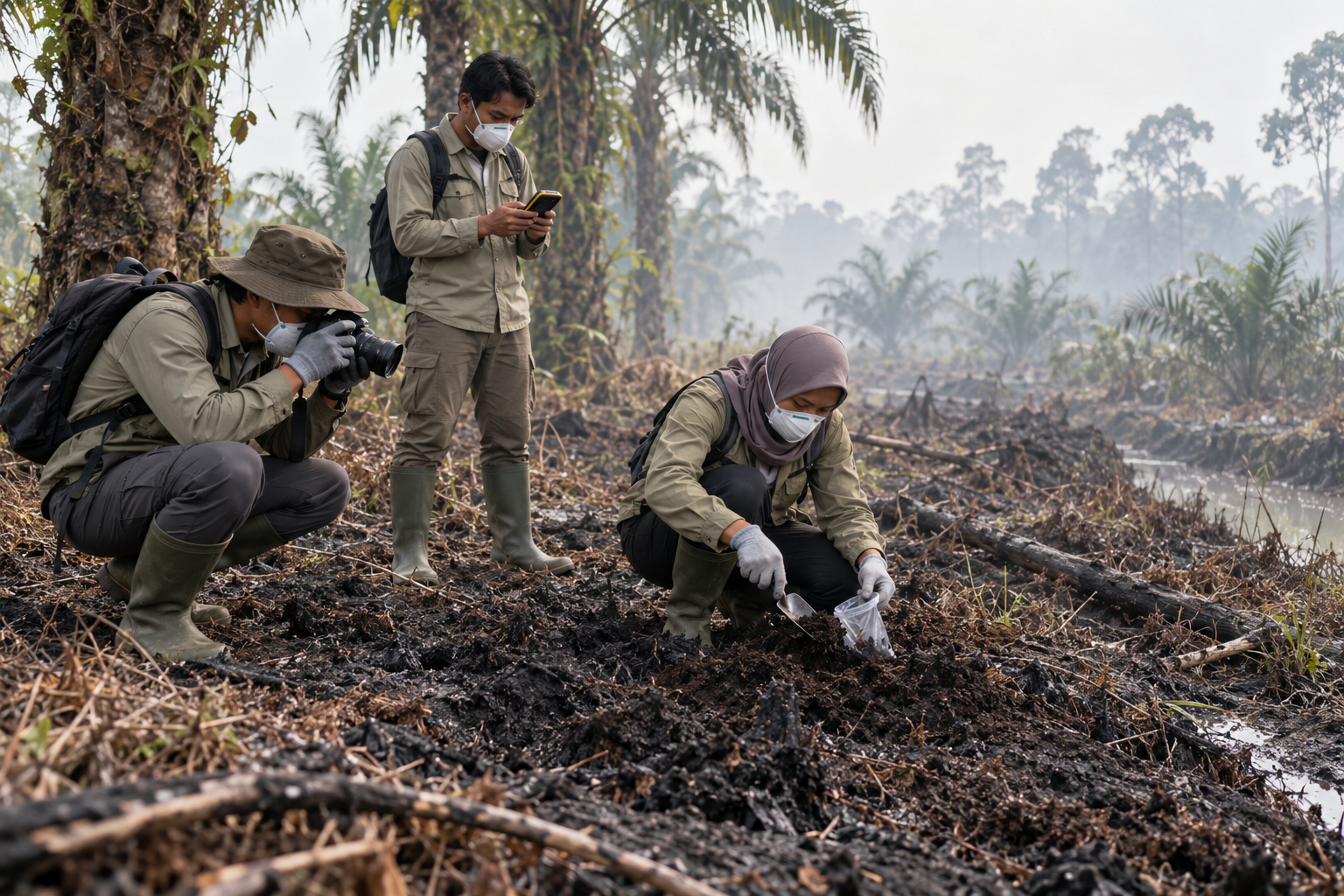
Field investigation of forest fires and haze · AI-generated
Singapore's and Indonesia's foreign ministers both identified the people of Sumatra and Kalimantan as the first victims of the haze. With smoke from forest and land fires threatening residents' health, Singapore's Vivian Balakrishnan and Indonesia's Arrmanatha Nasir agreed in Jakarta on October 27 to establish a joint task force to hold companies connected to the fires accountable. They agreed to share information linking burned land with companies registered in another country. Singapore foreign ministry's official transcript, CNA's report on the joint press conference
Nasir proposed the task force and Balakrishnan agreed. According to CNA's account of Nasir's explanation, it will share corporate and financial information, gather evidence across borders and, where possible, pursue asset recovery. Indonesia's Antara news agency likewise reported that cooperation would cover corporate financial flows and cross-border evidence gathering. CNA, Antara
After issuing notices to 10 Indonesian companies, Singapore's National Environment Agency sent notices requesting documents and information to 10 Singapore-registered palm-oil and forestry-related companies on October 23. According to CNA, the requests covered links between affiliated companies in the two countries, the locations of land concessions, and fire-prevention and firefighting measures. Sustainability and Environment Minister Grace Fu had said on October 19 that the agency would also trace corporate relationships across countries, including shareholders, customers and subsidiaries. Investigators aim to establish responsibility by connecting the land producing smoke with its operators and the companies that control or do business with them. CNA's account of the NEA notices, Singapore sustainability and environment ministry transcript, October 19
In CNA's October 26 reporting on the individual companies, those that received the Singapore notices acknowledged receipt, and many said they would cooperate. Some acknowledged fires or hotspots within their operating areas while denying that their operations had caused or worsened the haze. CNA's reporting on companies' statements and responses
Cross-border investigation has long been difficult. On October 12, CNA cited the National Environment Agency as saying investigations into four Indonesian companies connected to the 2015 haze were still ongoing. The agency described difficulties identifying the companies responsible for overseas fires and obtaining evidence across borders. Through the new task force, the two governments are committing to collect the corporate and financial information and on-site evidence needed for that work together. CNA's reporting on the earlier investigations, The task force's information- and evidence-gathering role
The meeting also took place amid continuing friction over gas supplies. Antara reported that the ministers met against the backdrop of reduced Indonesian gas exports to Singapore and a dispute over compliance with contracts. According to CNA, the two countries also agreed to establish direct contacts at ministerial and senior-official levels to address bilateral disagreements. Antara's reporting on the meeting's context, CNA's report on direct-contact arrangements
EEJE Editorial Analysis: The central task is to connect fire sites with corporate financial flows. To address smoke that harms the health of people in both Indonesia and Singapore, the two governments have agreed to pursue accountability by tracing companies and money on both sides of the border together. Singapore foreign minister's official remarks, Report on the Indonesian foreign minister's remarks
A retirement-pension saver sees “100%” on a product screen. The financial company means that the saver may put the entire pension balance into the product; the saver may read it as a sign that retirement money will be safe. On October 27, the Financial Supervisory Service (FSS) said it had found some pension providers displaying only investment limits, without risk ratings, for ETFs that can lose money. It plans to require both pieces of information from next year. Savers need to know not only how much they can invest, but also what risk of loss they are taking on. FSS announcement
In the FSS's example of an active ETF investing in 30-year Korean government bonds, the risk rating changed even though savers remained permitted to invest their full balance. The fund was rated 5, or “low risk,” in August 2022, but moved to 3, or “moderately high risk,” in August this year. Once a fund has been operating for three years, its manager reassesses risk using fluctuations in its actual returns. Savers who remember only the explanation they read when they bought it may miss the change in risk. FSS materials, p. 4, Bizwatch report
A prospectus EEJE separately examined for Samsung Asset Management's KODEX 30-Year Korean Government Bond Active ETF explains the distinction in concrete terms. Effective August 13 this year, it rates the product at 3 and describes how rising interest rates can lower bond prices and cause losses of principal. Even investors in government bonds may receive less than they paid if they sell in the market before maturity. Holding government-issued bonds does not by itself protect the value a saver sees in a pension account. Samsung Asset Management prospectus, cover and p. 25
The FSS plans to require risk ratings alongside investment limits on trading and product-search screens, as well as in the product proposals financial companies give to savers. Existing holders will see a change too: risk ratings will be added to pension investment statements that report purchase amounts, valuation gains and losses, and other information. The measure is intended to let both new investors and long-standing account holders see how their products are currently classified. The target implementation date is January 2027; some providers with different IT-development schedules are expected to implement it during the first half of that year. FSS announcement and attachment, pp. 5–8, Bizwatch
Savers can already consult the latest prospectus to check the risk rating, whether principal can be lost and why the price changes. In particular, a product appearing near the top of a provider's proposal should not automatically be taken as a safe one. According to the FSS, products guaranteeing principal and interest are listed in descending order of interest rates, while investment-linked products are ranked according to the provider's assessment of their merits. The retirement a saver wants and the provider's ranking of products require separate judgments. FSS consumer guidance
EEJE Editorial Analysis: Financial companies must make the risk of loss clear where customers press the buy button. They should not consider their responsibility discharged by putting warnings inside a prospectus. Pension savers, in particular, are preparing for their future lives with money accumulated over many years. Providers must continue explaining changes in risk after the sale so that customers can judge when, and on what terms, they can draw money for living expenses. The success of this reform will depend on more than adding a risk-rating label. It requires changes to the actual screens and advice so that customers do not confuse permission to invest all their money with a promise to preserve all of it.
Anti-Scam Staff Wages Counted as “Social Contribution”: FSS Calls on Bank Boards to Scrutinize Results
EEJE Editorial Team · English edition
Banks’ work to protect customers · AI-generated
If a bank presents the wages it pays staff to stop fraudsters taking customers' money as a social contribution, customers are being asked to applaud its basic work as a good deed. In materials for an October 28 meeting with the chairs of bank holding companies, the Financial Supervisory Service (FSS) cited such costs as an example of social contribution for show. It also named sponsorship of local-government events aimed at winning municipal banking contracts and spending on events to attract new customers. That is why readers should first examine what banks count as a contribution, rather than simply how much they say they spent. FSS meeting materials, p. 3
The banking sector's social-contribution total exceeded 2 trillion won for the first time in the previous year's results announced this year. Yonhap's May report on the Korea Federation of Banks' figures put the total at 2.156 trillion won. The FSS also acknowledged progress in banks' fulfillment of their social responsibilities at this meeting. At the same time, it called on boards to establish medium- and long-term plans and examine actual results. Directors are being asked to check whether announced spending translates into help for the people who need it. Yonhap's coverage of the Korea Federation of Banks report, FSS materials, p. 3
EEJE compared two passages in the announcement dealing with customer protection. On page 2, the FSS described information security as a core financial-company function that protects customers' assets and information. It urged boards to take an active role rather than viewing security investment merely as a cost. On page 3, it criticized the presentation of wages for call-center staff responding to telephone scams as a social contribution. Read together, these passages call for a distinction between what a bank must do to conduct its business and what it contributes to society beyond that work. FSS original materials, pp. 2–3
At the same meeting, the FSS asked boards to consider access for older people and other financially vulnerable customers when making decisions about branches. Banks calculate a branch's income and costs, but customers go there to withdraw money and ask staff how to carry out transactions. For customers unfamiliar with digital banking in particular, access to a staff member and a service counter can determine whether they can use financial services at all. When boards assess social contribution, their business judgments must also consider whether customers can actually use the bank. FSS materials, p. 3
FSS Governor Lee Chan-jin called on directors to go beyond rubber-stamping management proposals, actively request information and draw on outside experts. EBN covered the meeting primarily through its demands for substantive board deliberation and proper CEO succession procedures. Social contribution is another business judgment directors must scrutinize. To get beyond numbers prepared for announcements, they need to ask whether operating expenses have been included, whether support plans have been carried out and whether customers have benefited. FSS materials, p. 3, EBN's report on the meeting
EEJE Editorial Analysis: Banks explaining their social contribution should show what lasting help recipients received. Mixing in the cost of securing municipal banking contracts and the wages needed to protect customers makes those results difficult to judge. Boards should demand an itemized account of spending purposes and outcomes for beneficiaries, and disclose basic business functions separately from additional support. A bank should have someone to answer when a customer faces a scam, and a counter where people can get help with difficult transactions. Banks should fulfill those everyday responsibilities while speaking of their contribution to society.